Guide·July 30, 2026·8 min read
Six questions to run before you write a single word of SEO content.
Most content strategies fail before the first draft is written. The topic looked promising, but no one asked whether the query actually wanted that shape of content, or whether the site had enough authority to compete, or whether anyone else could write the same post in an afternoon. This is a framework for catching those problems before you spend the time.
1. Search intent — the biggest lever, and most people get it backwards
Every query has an intent: informational (“what is X”), navigational (“Product Hunt login”), commercial-investigative (“best X for Y”), or transactional (“submit product free”). Google tries to match the content type to the intent, not just the keyword. A listicle ranks for “best X” queries. A how-to ranks for “how do I X.” A tool or directory page ranks for “X submission” queries.
If you write a beautiful essay for a query that wants a comparison table, you will not rank no matter how good the writing is. The first filter is always: what shape of content does this query actually want to see? Open an incognito window, search the phrase, and look at what is already ranking. The existing results tell you what Google has already decided the intent is.
2. Volume vs. competition — the trade you are actually making
Every topic sits somewhere on a two-axis grid, and where it sits determines whether it is worth your time right now:
- High volume + high competition: Big prize, but you are fighting sites with years of domain authority. A new or small site basically cannot win here yet.
- Low volume + low competition: Small prize each, but it stacks, and you can actually rank in weeks rather than years.
- High volume + low competition: The unicorn. Rare, but it is what you are hunting for. When you find one, move on it immediately.
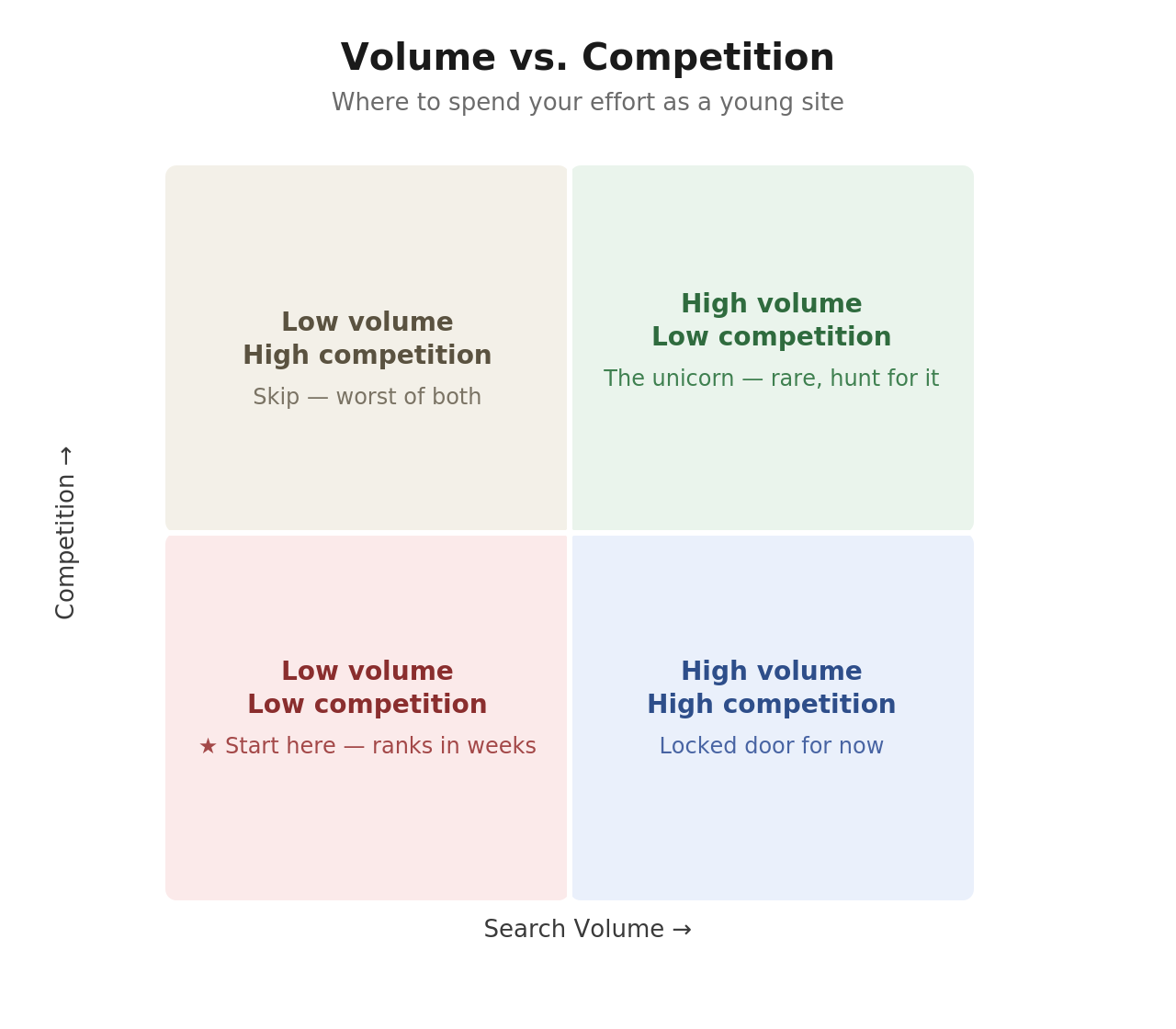
For a young site, long-tail and specific is the only door that is actually open right now. “Product Hunt alternatives” is a locked door. “Free dofollow backlink sites for indie founders” is a door with a weaker lock. That is not a consolation prize — it is the only realistic path to ranking and building the authority to compete on bigger phrases later.
3. Topical authority — Google trusts clusters, not singles
One good post proves nothing to Google. Ten interlinked posts about the same neighborhood of topics — launch platforms, indie SEO, maker tools, backlinks — tell Google this site actually knows this space. That accumulated trust is what topical authority means, and it is how a smaller site can eventually outrank a bigger one on its own turf.
This changes how you should think about individual content decisions. The question is not just “is this a good post?” It is “does this post fit into a cluster?” A comparison piece, a how-to, an algorithm explainer, and a data report — all cross-linked — is a stronger position than the same four posts sitting isolated. Pick a cluster first, then fill it in.
4. The unique asset test — the one most people skip
Ask one question about any topic you are considering: could literally anyone else write this same post with a Google search and a few hours?
If yes, you are competing purely on domain authority — which a new site does not have, so you lose. If no — because it uses data, experience, or an angle only you have: your own submission volume, your own reaction data, your niche vantage point as someone inside the space — you are competing on originality. A small site can actually win that fight.
This is why data reports and teardowns tend to beat generic listicles for a young site specifically. They are the content type a bigger competitor cannot replicate overnight. If you have first-party data, use it. If you have an experience that is genuinely yours, write from it.
5. Funnel stage — who you are actually trying to reach
Content at different stages of the funnel does very different jobs:
- Top-of-funnel: Broad, informational. Builds traffic and backlinks, but visitors are far from taking any action. Good for authority, slow for conversions.
- Mid-funnel: Comparison, "vs," "best of." Visitors are actively evaluating, closer to a decision. This is where SEO traffic and actual signups tend to overlap most.
- Bottom-of-funnel: Branded, transactional, "how to submit to [product]." Highest intent, lowest volume, easiest conversion once someone finds it.
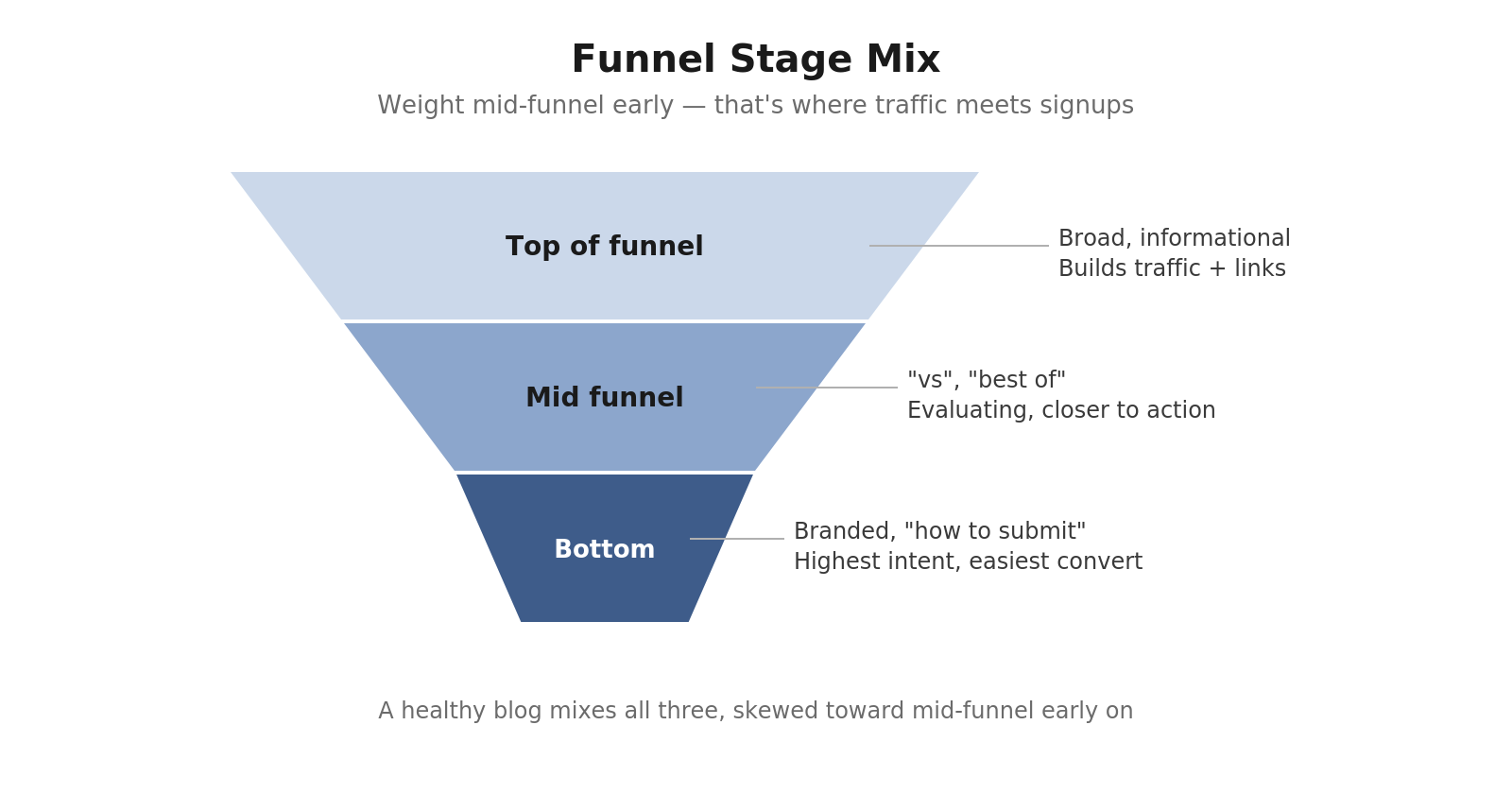
A healthy blog has all three, but the weight should shift over time. Early on, mid-funnel is where the best return tends to be: specific enough to attract people close to a decision, broad enough to get real search volume. Pure top-of-funnel is a slow burn. Pure bottom-of-funnel runs out of topics fast.
6. Freshness and decay — what you are signing up for
Some content decays; some does not. “Best of 2026” roundups are freshness-dependent — they need updating or they rot and lose rank. “How X works” posts are conceptual and evergreen — they do not decay the same way and can hold a ranking for years with minimal maintenance.
Knowing which genre you are picking upfront tells you what you are committing to. A data report published once might hold its position for a long time. An annual list of tools requires a refresh every twelve months or it starts to slip. Neither is wrong — but you should go in with eyes open about the ongoing cost.
The actual filter
Before naming any topic, run it through four questions:
- What intent shape does this query want, and does my planned content match it?
- What competition tier can I realistically win right now, given the site's current authority?
- Does this fit into a cluster, or is it a one-off that does not build toward anything?
- Do I have a unique asset — data, experience, or a vantage point — that makes this hard to copy?
If a topic clears all four, it is worth writing. If it only clears one or two, save it for later — once the site has more authority to spend, or until you find a unique angle that makes it defensible. The discipline is in the filter, not the writing.
Frequently asked questions
What is the most important factor when picking an SEO topic?
Search intent. Google matches content type to the query intent, not just the keyword. If you write a beautiful essay for a query that wants a comparison table, you will not rank regardless of writing quality. Nail the intent shape first, then evaluate everything else.
Can a new site rank for high-volume keywords?
Rarely, and not quickly. High-volume keywords almost always come with high competition from sites with more domain authority. For a young site, long-tail and specific topics are the only door that is actually open right now — not because they are a consolation prize, but because they can rank in weeks rather than years.
What does topical authority mean in practice?
It means Google learns to trust your site on a subject because you have multiple interlinked posts covering the same neighborhood of topics. One good post proves nothing. Ten interlinked posts about related angles — comparison pieces, how-tos, data reports, explainers — tell Google this site actually knows this space.
What makes a piece of content hard to copy?
It uses data, experience, or an angle that only you have. If anyone could write the same post with a Google search and a few hours, you are competing on domain authority — which a new site does not have. Data reports, teardowns, and posts built from your own firsthand experience are the content types a bigger competitor cannot replicate overnight.
What is the difference between evergreen content and freshness-dependent content?
"How X works" posts are conceptual and evergreen — they do not decay the same way. "Best of 2026" posts are freshness-dependent — they need updating or they rot and lose rank. Knowing which genre you are writing upfront tells you whether you are committing to a one-time post or an ongoing maintenance obligation.
Found an article worth reading? Submit it.
Spotlitely is where developers, designers, and indie makers share the links worth keeping. Paste a URL, add a real title and description, and it goes live immediately for the community to react to.
Submit a linkPriyanshu Singh
Founder, Spotlitely — a launch platform for indie makers. Writing about what actually moves the needle in product discovery.
You may also like