Guide·July 30, 2026·5 min read
The click isn't the prize anymore. Here's what actually changed.
SEO is not dead, but the thing you are competing for shifted. Ranking #1 used to mean traffic. In 2026 it increasingly means Google answers the question itself above your listing and most people never scroll further. Here is what is actually happening and what it means for how you should write.
1. Rankings are becoming a vanity metric
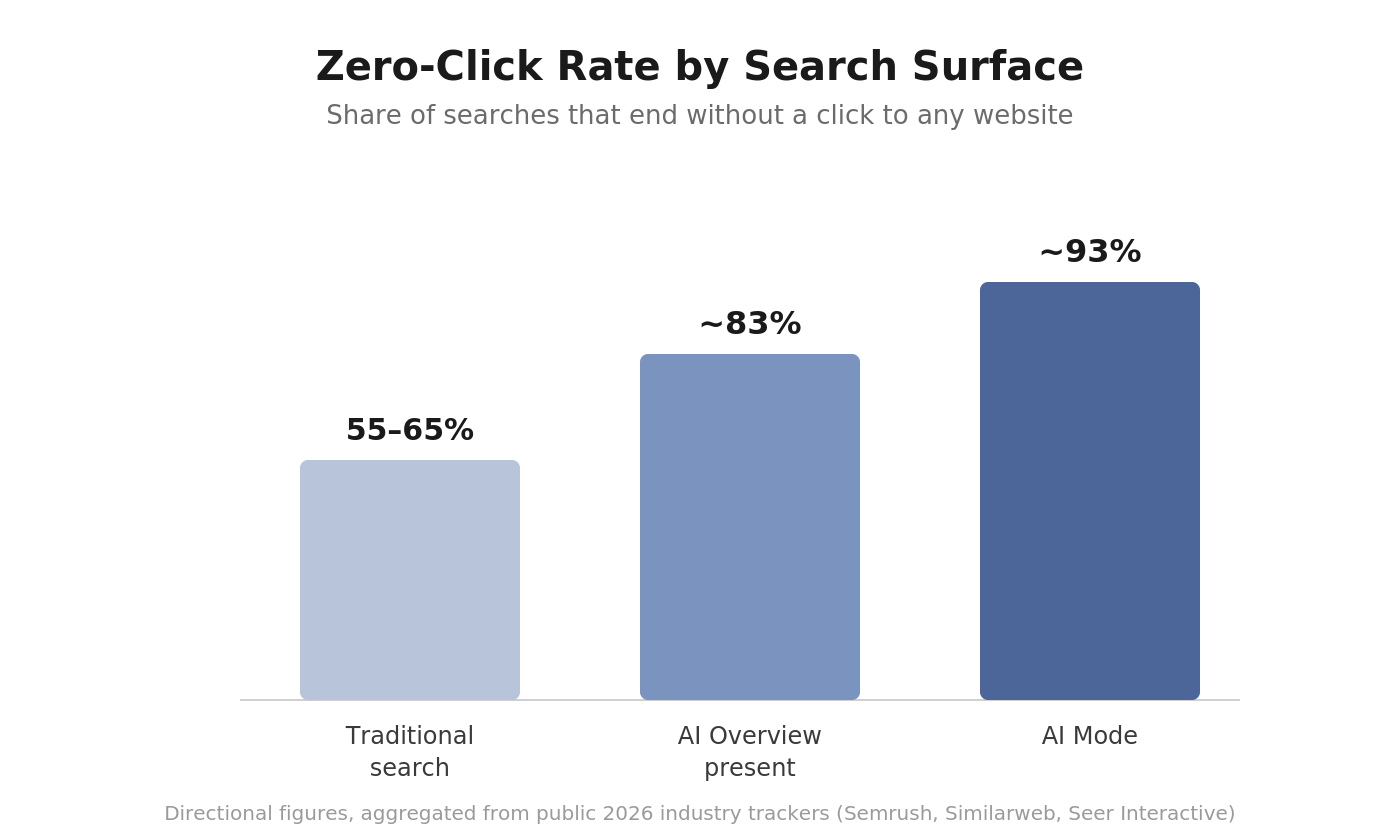
When Google shows an AI Mode answer instead of a normal results page, roughly 9 out of 10 of those searches end without a click to any website. AI Overviews — the summary box that sits above regular results rather than replacing them — have grown fast too: from under a third of tracked queries in early 2025 to close to half by early 2026, according to trackers like Semrush and BrightEdge. In health, finance, and legal categories, that share runs well above the average.
You can rank #1 for a query and get almost nothing from it, because Google just answers the question itself above your listing. Sites that have not adapted are seeing real, measurable traffic declines specifically on informational queries.
What this means concretely: pure “what is X” / “how does X work” content is a worse bet than it used to be — Google eats those. Content tied to action (submit, compare, choose, buy) survives better, because transactional searches are mostly unaffected. People still click through when they are actually about to do something.
2. The new prize is the citation, not the click
The smarter reframe is not “SEO is dead” — it is that the win shifted. You are not just trying to rank anymore; you are trying to be the thing the AI Overview quotes. AI Overviews tend to reward clarity and topical relevance over keyword stuffing, and favor pages that clearly define concepts and explain processes in a structured way. That is why pages outside the top 10 sometimes still get cited.
You can “win” without ever seeing the traffic in Analytics. Being the source an AI paraphrases is now a real, if invisible, form of distribution. Write for the citation, not just the click.
3. Backlinks did not die, but their job changed
Traditional backlinks still move traditional rankings for transactional searches. But for AI-citation purposes specifically, brand mentions and entity authority seem to matter more — a mention in one respected publication can outweigh dozens of low-quality directory links.
The old “get 50 backlinks from directories” game is losing potency. One real mention from a site people — and AI — actually trust beats a pile of forgettable ones.
4. AI Overviews cite Reddit — opinionated content is winning
Google's AI Overviews pull from a range of sources, not a single authoritative one, and platforms like Reddit are showing up more often — cited for real-world, community discussion rather than generic reference content.
This should change how you write. Sanitized, generic “10 tips for X” content is exactly what AI now summarizes instead of sending anyone to you. Opinionated, first-person, “here is what actually happened when I did X” content is harder to flatten into a summary and more likely to get cited by name. The content type that is easiest to generate at scale is the one AI will replace first.
5. New sites are invisible for months regardless of quality
This is the unglamorous mechanical truth that most SEO guides skip. New domains sit in a low-trust holding pattern where even good content just does not rank yet, no matter how well-optimized it is. Google has never confirmed a formal sandbox mechanism, but the effect is widely reported: backlinks, consistent publishing, and time are what seem to move the needle — not better keyword research.
If you publish one great post and check rankings two weeks later, you are checking too early. Plan for a multi-month lag before Google trusts a young domain enough to rank it competitively. That is not a reason to write worse content — it is a reason to stop expecting fast results and keep publishing anyway.
The blunt version of all of it
SEO in 2026 is not “write good content and rank.” The full picture is:
- Pick content Google won't fully answer for the user itself — transactional and commercial queries survive; pure informational ones increasingly don't.
- Make it hard to summarize because it is specific, opinionated, or data-backed — generic content is what AI replaces.
- Earn a small number of real mentions rather than many fake ones — one trusted citation beats fifty directories.
- Accept a multi-month lag before any of it shows up — quality does not shortcut the trust timeline for a new domain.
- Measure citations and brand mentions, not just clicks — clicks are structurally declining even for content that is winning.
The mechanics changed. The discipline — publish consistently, earn real authority, write things that are hard to copy — did not.
Frequently asked questions
What are AI Overviews and how do they affect SEO traffic?
AI Overviews are summary boxes that appear above regular search results. When Google shows one, roughly 9 out of 10 searches end without a click to any website. They have grown from under a third of tracked queries in early 2025 to close to half by early 2026, with even higher rates in health, finance, and legal categories.
Does ranking #1 still matter in 2026?
For transactional and commercial queries, yes — people still click through when they are actually about to do something. For pure informational queries ("what is X," "how does X work"), ranking #1 matters far less because Google now answers those questions itself above your listing. You can rank first and receive almost no traffic.
How do you get cited in an AI Overview?
AI Overviews tend to reward clarity and topical relevance over keyword density, and favor pages that clearly define concepts and explain processes in a structured way. Opinionated, first-person, and data-backed content is also more likely to be cited by name — generic "10 tips for X" content is exactly what AI summarizes instead of sending anyone to.
Are backlinks still important in 2026?
Traditional backlinks still move rankings for transactional searches. But for AI-citation purposes, brand mentions and entity authority seem to matter more. One real mention from a site people and AI actually trust now outweighs dozens of low-quality directory links.
How long before a new site starts ranking?
Plan for a multi-month lag. New domains sit in a low-trust holding pattern where even well-optimized content does not rank competitively yet. Backlinks, consistent publishing, and time are what move the needle — not better keyword research. If you publish one great post and check rankings two weeks later, you are checking too early.
Found an article worth reading? Submit it.
Spotlitely is where developers, designers, and indie makers share the links worth keeping. Paste a URL, add a real title and description, and it goes live immediately for the community to react to.
Submit a linkPriyanshu Singh
Founder, Spotlitely — a launch platform for indie makers. Writing about what actually moves the needle in product discovery.
You may also like