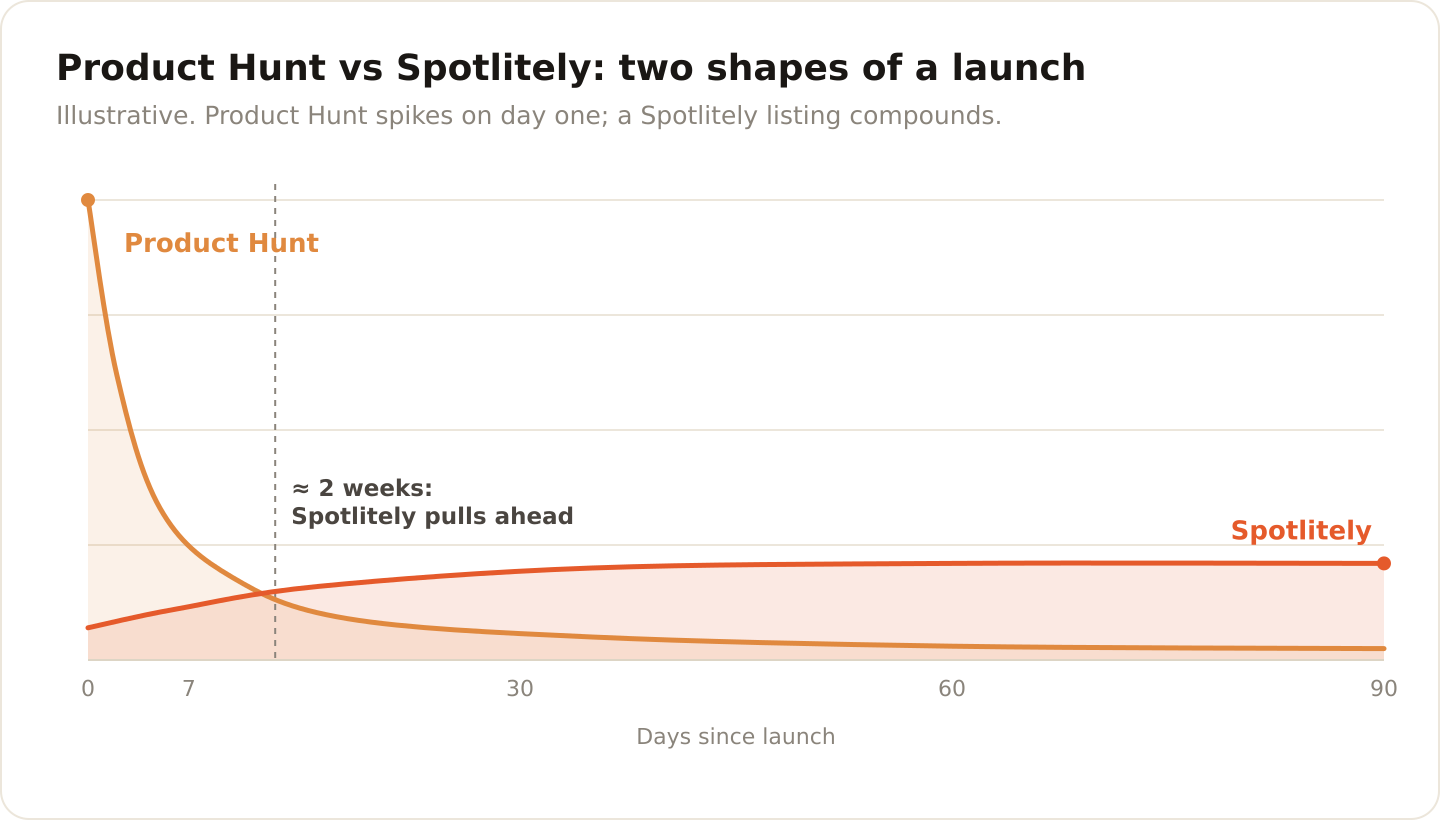
Short version: Product Hunt is a launch-day event, a big spike of attention in 24 hours if you have an audience to mobilise. Spotlitely is a permanent, indexable listing built to keep getting found for months, with no launch window. They solve different problems, and most makers should use both.
Disclosure: we build Spotlitely. We have tried to keep this fair, Product Hunt does things Spotlitely simply cannot, and we say so plainly below.
A launch-day event. A big spike of attention in 24 hours, if you have an audience to mobilise.
Best for A coordinated launch with an audience ready to show up.
A permanent, indexable listing built to keep getting found for months, with no launch window.
Best for Lasting discovery, backlinks, and AI-search visibility without a launch day.
Product Hunt sells you a day. Spotlitely sells you a page. Almost every other difference follows from that one. Product Hunt concentrates everything into a 24-hour leaderboard, so the payoff is a spike, huge if you win the day, small if you do not. Spotlitely spreads it out into a permanent listing that keeps getting found, so the payoff is slower but it does not expire.
On Product Hunt you either post the product yourself or line up a hunter to do it. Either way, submission is not the hard part, ranking is. Your position is decided by how much momentum you gather in the first few hours, which quietly favours makers who already have an audience or a well-connected hunter.
On Spotlitely there is no hunter and no approval queue. You paste the link, add a title and description, and it is live in about a minute at a readable permalink like spotlitely.com/l/your-product. Nothing is gated behind a launch-day scramble.
This is the real fork. Product Hunt runs on a daily leaderboard: rank well and you land in the email digest that reaches hundreds of thousands, fade and you are off the front page by mid-afternoon. The page stays live, but the traffic does not.
Spotlitely has no window to beat. The listing stays indexed and keeps collecting reactions, and instead of waiting months to relaunch, you can repost it every 15 days with a public changelog to get a fresh run in the feed. Past reactions, clicks and points are banked, never reset, so a product that keeps shipping keeps showing up.
Here Product Hunt simply wins on size. Its audience of tech early adopters, founders, press and investors is the largest of any launch platform, and the daily digest has no equivalent anywhere. If your goal is raw day-one reach, nothing matches it.
Spotlitely's audience is smaller and still growing, made up of makers and curators rather than a broad consumer crowd, and there is no large email digest yet. We would rather say that plainly than pretend otherwise. What Spotlitely trades size for is permanence and lower competition, an early-stage product that would be invisible on Product Hunt can actually be seen and stay seen.
Both give you a permanent page, but the link behaves differently. Product Hunt product pages are nofollow, so the direct link passes no ranking signal, though a top launch earns followed links indirectly from the many sites that scrape the front page.
Every Spotlitely listing gets a page and a backlink, with a dofollow link granted to standout listings, plus structured schema markup (WebPage, WebSite, BreadcrumbList) that tells Google and AI search engines like ChatGPT and Perplexity exactly what your product is. If part of why you launch is SEO and being found by AI, that is a real difference.
| Spotlitely | Product Hunt | |
|---|---|---|
| How you get listed | Instant, no hunter, live in ~60 seconds | Post yourself or via a hunter |
| Approval queue | None | None, but ranking is gated by day-one momentum |
| Visibility model | Permanent, repost every 15 days with a changelog | 24-hour leaderboard |
| Launch window | None | Decided in the first few hours |
| Audience size | Growing | Very large |
| Audience type | Makers and curators | Consumers, founders, tech early adopters |
| Email digest | Not yet | Daily, to hundreds of thousands |
| Backlink | Page + backlink, dofollow for standout listings | Nofollow, permanent page |
| Schema / AI search | WebPage, WebSite, BreadcrumbList, built for AI search | Limited |
| Cost | Free | Free (paid promo available) |
| Best-case outcome | Compounding discovery over months | Thousands of visits on day one |
| The honest downside | Small early audience, no day-one spike | Little return if you are pre-audience |
Backlink types and platform details verified August 2026.
Reach for Product Hunt when:
For the right launch, nothing else delivers a day-one spike like it. Do it once, properly.
Reach for Spotlitely when:
These are not really competitors so much as two stages of the same job. Launch on Product Hunt for the spike, list on Spotlitely for the long tail that keeps working after launch day is over. The products that get traction are usually the ones that keep showing up, not the ones that bet everything on a single morning.
If you want the full picture, see the best Product Hunt alternatives and how to plan a product launch as a sequence.
Yes, but a different kind. Product Hunt is a same-day leaderboard; Spotlitely is a permanent listing with no launch window. It is best thought of as a complement to Product Hunt rather than a replacement, so most makers use both.
Neither is simply better. They do different jobs. Product Hunt wins on raw reach and a single-day spike. Spotlitely wins on permanence, a real dofollow backlink for standout listings, and structured data for AI search. Pick by what you need this month.
No fixed window. Your listing goes live instantly and keeps accumulating reactions. Instead of waiting months to relaunch, you can repost every 15 days with a public changelog, and past reactions, clicks and points are banked rather than reset.
Product Hunt product pages are nofollow, so the link passes no ranking signal, though a top launch earns followed links indirectly from aggregators. Every Spotlitely listing gets a page and a backlink, with a dofollow link granted to standout listings. For link equity, Spotlitely; for a burst of referral traffic on a big day, Product Hunt.
Yes, and you should. Launch on Product Hunt for the day-one spike, and list on Spotlitely for the long tail that keeps working after launch day. They reach different audiences on different timelines.
Give your launch a permanent home. Submit to Spotlitely in 60 seconds.
Instant listing, a permanent readable permalink, schema markup for Google and AI search, and a repost every 15 days with a public changelog. No launch window to beat.
You may also like
